Wednesday, 18 April 2012

Q for Quality or quantity

Love food Hate waste poster

I am not surprised to see that supermarkets are under pressure to ban buy-one-get-one-free offers [with the charming acronym BOGOF] because it seems in the UK alone they may be creating a £13.7billion-a-year mountain of wasted fresh produce. 
ubiquitous BOGOF

Although we worry about rising bills, households are throwing away an average of £520 of good food and drink a year. Last year the government even set up a Love food, Hate waste campaign to try and tackle it. Sadly, there are numerous cartoons out there with the joke “Buy one, throw the other one away”..

On the quality front there are moves in the UK this year to cut down on some of the sell buy dates on food that many people slavishly follow – another source of waste – in the mistaken belief that the food is not of sufficient quality to be consumed.
waste poster from thisismoney.co.uk

Some councils now offer kerbside collection for food waste so that at least it does not go to landfill – mine included and it is amazing how heavy the bin is every week.

P for Plastics


I can hold my head up here - I have actually written to my local paper about plastics and recycling them. Plastics are a major offender in the packaging of items from foodstuffs to postal cushioning. A lot of packaging materials are made from polyethylene (PE) and polypropylene (PP). These are biodegradable, but require a lot of time and special conditions to degrade and are not considered viable to recycle – certainly in the UK which still does not have household collection of plastics everywhere.
It is hard to find out about if the plastics we put in our recycling bins are actually recycled. We tend to go by the numbers on the base. The symbols here – polymer ID or PET codes - were actually developed by the American plastics industry to give the plastic recycling industry a rough guide to the many different plastic polymers in use today. But the symbols do not necessarily mean that a plastic can be recycled and they often cause confusion. It does seem, in the UK at least,  that those with code 1 and 2 are recycled if they are bottles but beyond that who can say?
Cartoon from  www.ecologycenter.org home to the
International Plastics Task Force. 
 
I am using the word "recycle" but plastics don't actually get reformed back into the original products but are reprocessed into secondary (and usually non-recyclable) products. 

There are packaging companies all around the world trying to come up with solutions to replace the PE and PP granules with natural materials like starch, corn, wood pulp and cotton, potato, sugar-beet, soy, tobacco, sugar cane, cellulose and lignite. Read more on eHow and Which.

Monday, 16 April 2012

O for Organic


Organic products are grown using methods and materials that have a low impact on the environment. Organic production systems replenish and maintain soil fertility, reduce the use of toxic and persistent pesticides and fertilizers, and build biologically diverse agriculture.

In theory I would love to embrace all that is organic in my everyday life from the food I eat to the clothes I wear [dubbed eco fashion!] to the cleaning and beauty products I use. Who can argue with the fact that the use of pesticides is considered unhealthy and hazardous to the environment and human health in general or that we should adopt “an organic approach to a sustainable future for people and our planet”?
Organic fruit and veg
Actually quite a few – on the grounds of it not being possible to feed the world on organic food alone and the higher land and labour use for food production [as yields are smaller you have to cut down more trees, or plough up more land or disturb more wildlife] to name but three counter arguments.

And I am an old cynic and have images of vegetables marked organic being rubbed in mud to make them look more authentic and then the charge doubled! Well not quite but you know what I mean. There is certainly an expensive niche market out there – if I start on this I have to carry it through for everything I buy...


PS Why not visit a related topic on the use of palm oil and its affect on rainforests and animal habitats? http://lizbrownleepoet.com/2012/04/17/o-is-for-orangutan/

N for natural burial


I have long felt that I did not want my last act on earth to be a polluting one and the emergence of the natural burial or green funeral movement is very welcome. This writing by an unknown author says it very well

‘As we near the end of our journey on this world, we should remember those we leave behind.
We should allow them to remember the times we enjoyed, brief moments, long memories.
Our final resting place should be a symbol of our presence on earth.
It should be a part of nature, a part of the living, ever changing, ever growing, ever being.
A place where life gone is celebrated by life anew.
A wooded field, a part of England in a place of tranquillity and of beauty.’

I like the idea of the woodland burial now emerging here in which your role is to provide the sustenance for the soil, perhaps be part of a migration corridor for wildlife and be part of the something that will benefit future generations unlike traditional cemeteries which are overcrowded and built up and crematoria which are often atmosphere less conveyer belts. I like the idea of not seeing rows of decaying headstones too but a meadow and then a wood.
natural burials brochure cover

It seems to be amazing that even now we are not really geared up to this or thinking too much about it. This from a Co operative Society website about coffins:

Requests for more environmentally friendly coffins made from recycled or responsibly sourced materials are still very much in their infancy but are set to grow.

Sunday, 15 April 2012

M for Monitors


Energy Monitors are small wireless devices that hook up to your electricity supply to help you spot energy guzzling devices and activities, so you can cut back. They don't save you anything directly - it's about becoming more aware of habits. 

It is thought a monitor can help you slash 5-15% off your bill. This is all due to how you change your consumption once this has been highlighted for you - an energy monitor can help you get a better understanding of how you are currently using electricity and which of the appliances in your home are the most power hungry and how much CO2 you're emitting. Read more on the Which website.

Monitor picture from jugglefrogs.co.uk

Another of those eco devices that I probably should use but haven’t. I am not even sure having read both sides of the argument if I should turn off my broadband at night but I do turn off lights all the time as I go along at least and am aware of the kettle water and only boiling what I need and I don’t have a dishwasher. I think I would get so obsessive with a meter and it would make me miserable – does anyone use one?

Thursday, 12 April 2012

L for light pollution


The stark fact is that we are living in a world that expects to be lit up 24/7. Inefficient lighting wastes £1billion a year in the UK alone [CfDS]  and it also blights the view of the night sky and may also cause body clock havoc for birds, insects and small wild animals.

This thermal image map of the UK shows how widespread light pollution is with the dark blue areas having the least light pollution. Some think we should have legislation like the kind that bans dumping rubbish, for dumping light. Attention is being given to the angle of the beam of light so that it beams below and not above too. There have certainly been “lights out” initiatives in the US – over 17 cities have participated but what about the UK? 
Thermal image of UK
My partner was so keen to see a really dark sky not remembered since childhood and when we travelled to New Zealand last year we sat in open countryside until after midnight watching the sky and drinking in the novelty that was laid out there for us.

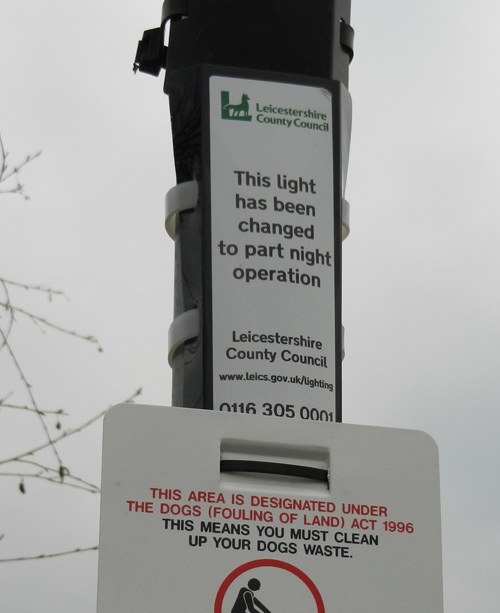
Campaigners have warned that the UK’s night skies are still “saturated” with light pollution, after a survey suggested half of the population are unable to see many stars. Councils across Britain have attempted to improve the situation by testing schemes to switch off or dim street lights. Of course cutting down on public lighting saves money too so we are starting to see initiatives to reduce  street light hours in some areas. 

light saver notice
This is a sign on a street lamp 20 feet from my house in a local park. 

More information from the CfDS which has a handbook, ”Blinded by the Light”,  available from its website

Wednesday, 11 April 2012

K for Kids and education


I think I started on this blog topic partly due to playing a game with my 3 year old grandson at Christmas – it was a recycling game where he had to recognise which items the cartoon bear was sending to which bins..glass, plastic or paper. As I have started to look at the whole eco idea in more detail I have come across all kinds of educational tools embedded into the curriculum and into play. These children should be so aware of environmental issues and from the very start. It should be second nature.

One of the easiest concepts to get across is recycling and look at all the books aimed at the different ages there are – just a few visuals of the many out there:
50 things for kids to recycle book
board book for toddlers

For children there are even websites aimed at helping them work out their carbon footprint . Check out Planet Positive.  

They can play online food miles games. I would have loved a wormery as a child or been involved in some of the more garden oriented initiatives aimed at conserving water. 
Take this online water conservation game.

eco board game
recycle picture book
recycling lorry toys

Many of these educational tools have multiple applications with science and maths and humanities playing their part as well as the message about how responsible citizens behave.